
How Coolaire Sustainably Powers Truck Refrigeration Operations

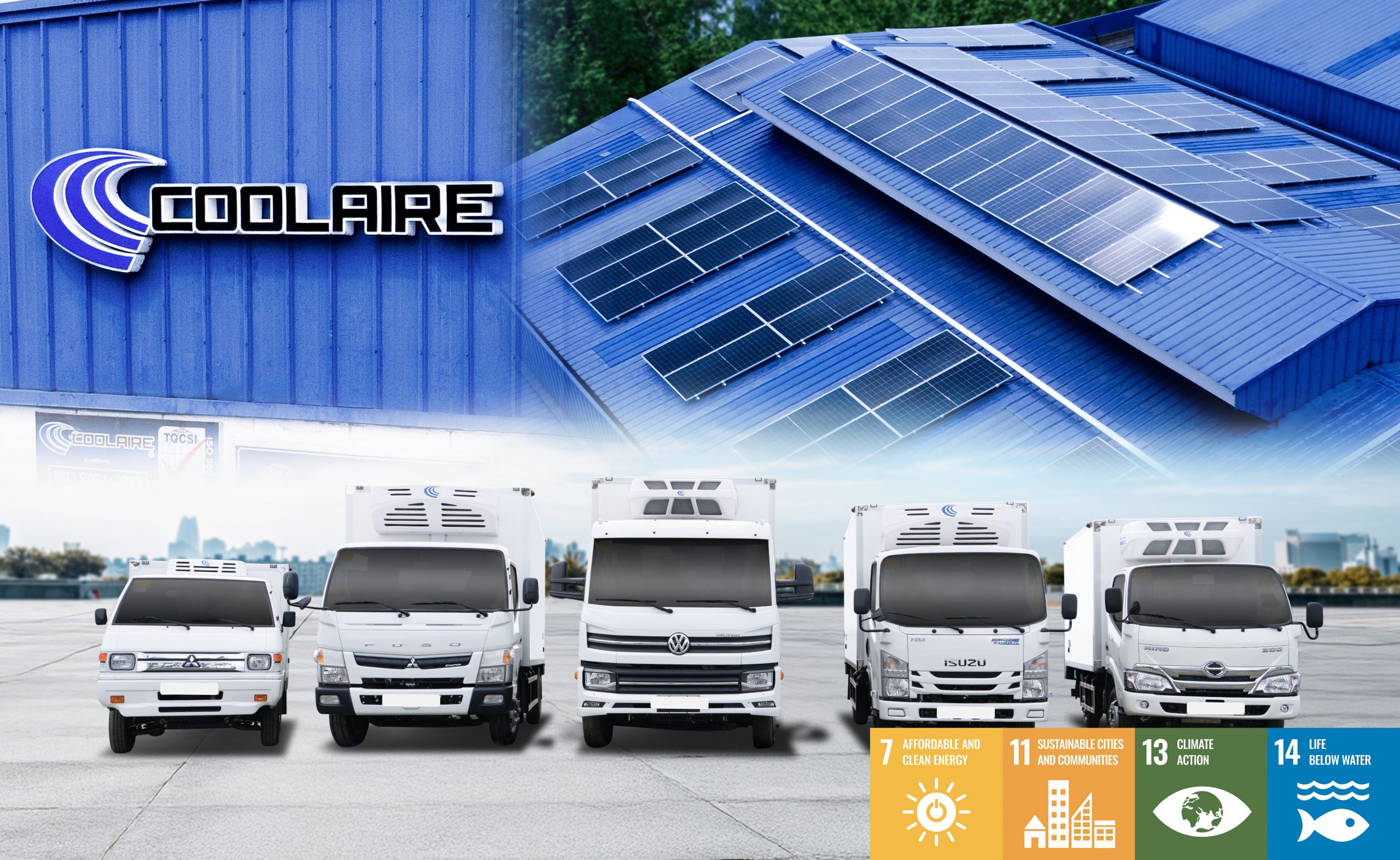
QUEZON CITY, Philippines — Coolaire Consolidated Inc. (Coolaire) reaffirms its commitment to sustainable business practices aligned with the United Nations Sustainable Development Goals (SDGs), particularly SDG 7 Affordable and Clean Energy, SDG 11 Sustainable Cities and Communities, SDG 13 Climate Action, and SDG 14 Life Below Water.
Among the company’s initiatives is investing in sustainable facilities to support environmentally responsible operations.
Coolaire’s largest production plant located in Bulacan is where all phases of the refrigerated van manufacturing happen—from body assembly, to product finishing and quality assurance. It is also the heart of Coolaire’s sustainability initiatives.
“Part of our commitment to climate action is reducing our reliance on the [electrical grid] by exploring other sources of renewable energy, with solar being the most applicable for our operations. We decided to do it first in Bulacan because most of our operations there require higher electrical loads,” said Joel Ryan E. Tugade, President of Coolaire.
Reducing dependence on conventional electrical grids is important because most rely on fossil fuels. Solar energy, on the other hand, is a cleaner alternative as it naturally generates energy from the sun, producing little to no greenhouse gas emissions.
Coolaire has since installed its first solar panel system at the main plant last year. Today, the system powers approximately 70% of the facility’s warehouse, production, and administrative operations.
From January to May 2026 alone, the system has generated a substantial amount of clean solar energy, contributing to reduced carbon emissions equivalent to Coolaire planting an urban forest.
On top of this, Coolaire has saved almost half a million of its electricity costs this year, a 40% reduction from before it started using solar energy.
“The savings that we are able to generate from the solar panels can, in turn, be used for employee development, workforce training, and facility improvement,” Joel Ryan shared.
Coolaire also boasts of a rainwater harvesting system built in response to water scarcity across its other facilities in Bulacan.
Water has always been essential to the plants’ daily operations and the needs of its nearly 300 employees. The system thus provides a more reliable and sustainable supply.
“We wanted to reduce our reliance on the regular water supply. Rainwater, like the sun, is a rich resource that we are not able to tap at the optimum level,” Patrick Joseph E. Tugade, Vice President of Coolaire, stated.
Since its installation, the system has collected close to 19,000 liters of water—enough to support the cleaning needs of almost 400 households.
A Long-Term Commitment to Sustainability
“Tapping renewable energy sources, especially in the field of truck refrigeration, helps us do our part in preserving the planet,” Joel Ryan emphasized.
“[Harnessing] natural resources like the rain and sun is important for us to achieve Coolaire’s goals towards not only the company’s prosperity, but also the prosperity of the people, too,” Patrick Joseph added.
Building on the success of its solar panels and rainwater harvesting systems, Coolaire plans to expand these initiatives across its other business centers in Luzon, Visayas, and Mindanao.
Moreover, these are not Coolaire’s only efforts for the environment. The company’s operations have always been rooted in its commitment to using materials with low global warming potential (GWP) and low ozone-depleting potential (ODP), ensuring that these align with international environmental standards like the Montreal and Kyoto Protocols.
Beyond this, Coolaire hopes that its initiatives will encourage its customers and partners to partake in climate action, whether by supporting the company or even in their own ways.
Overall, the company leaves a simple message: that meaningful environmental responsibility and business growth can go hand in hand. By preserving people’s dreams, Coolaire also helps preserve the world for future generations to come.
Interview and text by Raf Perez Inguito